Solana Instant Unstake: Exit Native Staking Instantly
Skip Solana's 2-day unstake cooldown. Marinade Instant Unstake converts native stake accounts to SOL in one atomic transaction through a competitive market-maker RFQ. No liquid token required.
Native staking on Solana is secure, but it is not instant to exit. When you deactivate a stake account, you wait for the network to process the change at an epoch boundary. That is roughly two days of your SOL being neither staked nor spendable.
Marinade Instant Unstake removes that wait. You convert a native stake account into liquid SOL in one transaction. You keep the benefits of native staking right up to the moment you exit, and you get liquidity when you actually need it.
This guide explains three things in order. First, how unstaking works at the protocol level and why the waiting period exists. Second, the problem this creates and why the common workaround has trade-offs. Third, how Marinade solves it with a competitive market-maker system that settles instantly and safely.
How Solana staking and unstaking actually work
To understand instant unstake, it helps to understand what a stake account does.
When you stake SOL natively, you do not send tokens to a protocol. You create a stake account, keep control of it, and delegate it to a validator. Your SOL stays in your own account the entire time. This is why native staking has no smart contract risk on the stake itself and why Marinade Native never takes custody of your assets.
A stake account moves through a defined lifecycle:
- Inactive. The SOL is in the stake account but not delegated.
- Activating (warmup). You have delegated, but the stake is not yet earning.
- Active. The stake is delegated and earning rewards each epoch.
- Deactivating (cooldown). You have started to unstake, but the SOL is not yet withdrawable.
- Inactive again. Deactivation is complete and the SOL can be withdrawn to your wallet.
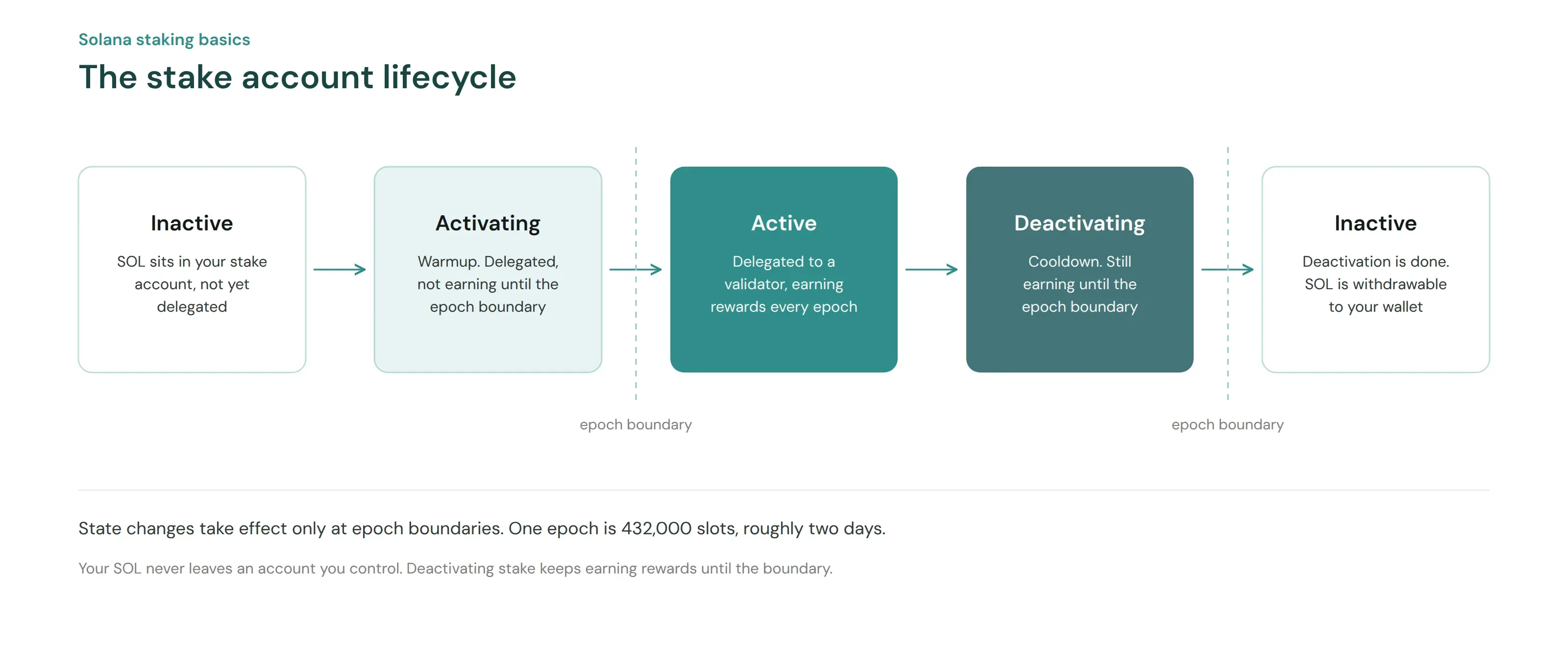
The key detail is that state changes only take effect at epoch boundaries. A Solana epoch is a fixed length of 432,000 slots at roughly 400 milliseconds each, which works out to about two days. Solana's own staking documentation states plainly that "an epoch is approximately 2 days long." Solana processes activation and deactivation only when an epoch ends, not at the moment you click a button.
Why the waiting period exists
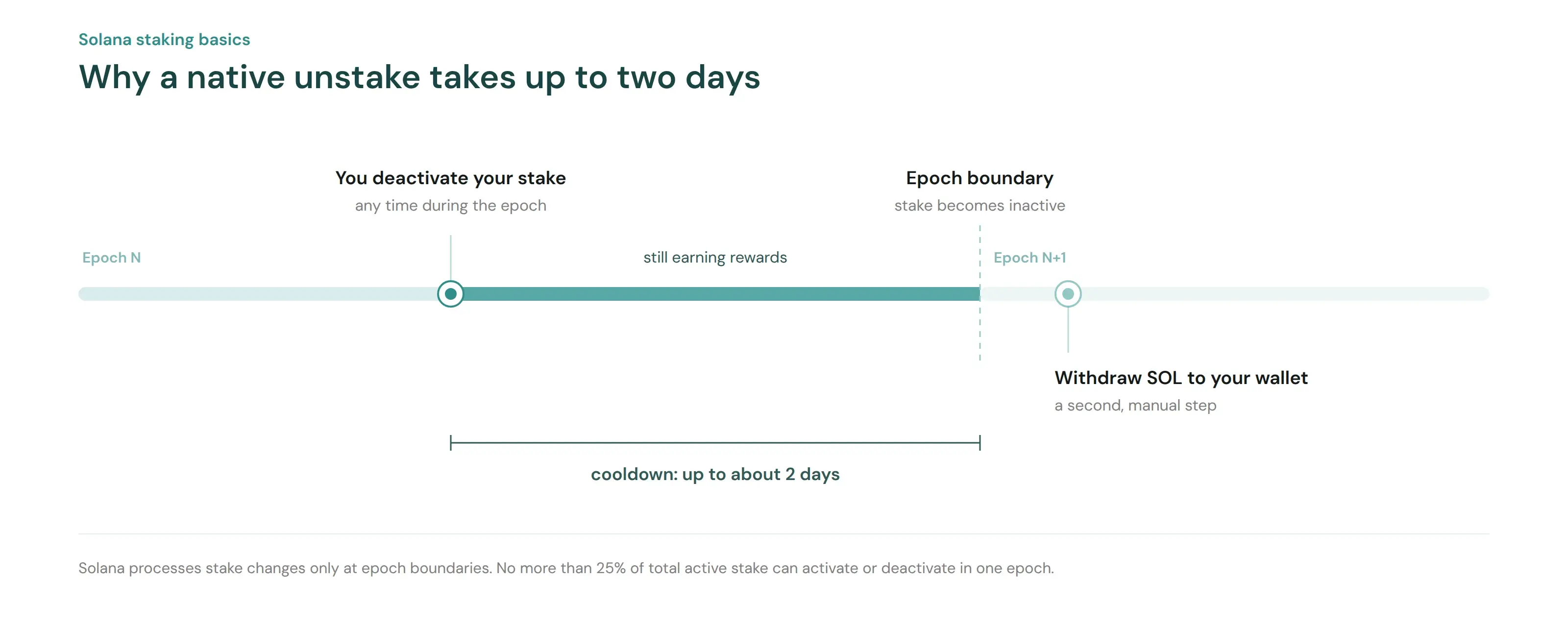
The cooldown is a network security feature, not an arbitrary delay. Solana limits how much stake can change state in a single epoch. In the words of Solana's official staking documentation, "No more than 25% of the total active stake on the network can be activated or deactivated in a single epoch." This prevents sudden, destabilizing swings in the validator set.
Because of this design, a normal native unstake follows a predictable but slow path. You deactivate your stake account. It sits in cooldown for the rest of the current epoch. At the next epoch boundary it becomes inactive. Then you return to the app or wallet and withdraw the SOL. In practice this takes up to about two days, and closer to a full epoch if you deactivate right after one begins. In rare periods of very heavy network churn, deactivation can span more than one epoch.
What happens to rewards during deactivation
Deactivating stake keeps earning until the epoch boundary. You do not forfeit rewards for the epoch you unstake in. Rewards on Solana auto-compound into the stake account each epoch, so there is no separate reward to claim during the wait. This is good news for long-term stakers, but it does not solve the liquidity problem for anyone who needs their SOL now.
One more point is worth stating clearly. Native staking on Solana has no slashing today. The main risks to a native staker are validator downtime and commission changes, both of which Marinade addresses separately through Protected Staking Rewards.
The problem: liquidity locked behind an epoch
The cooldown is fine when you are staking for the long run. It becomes a real cost when the market moves.
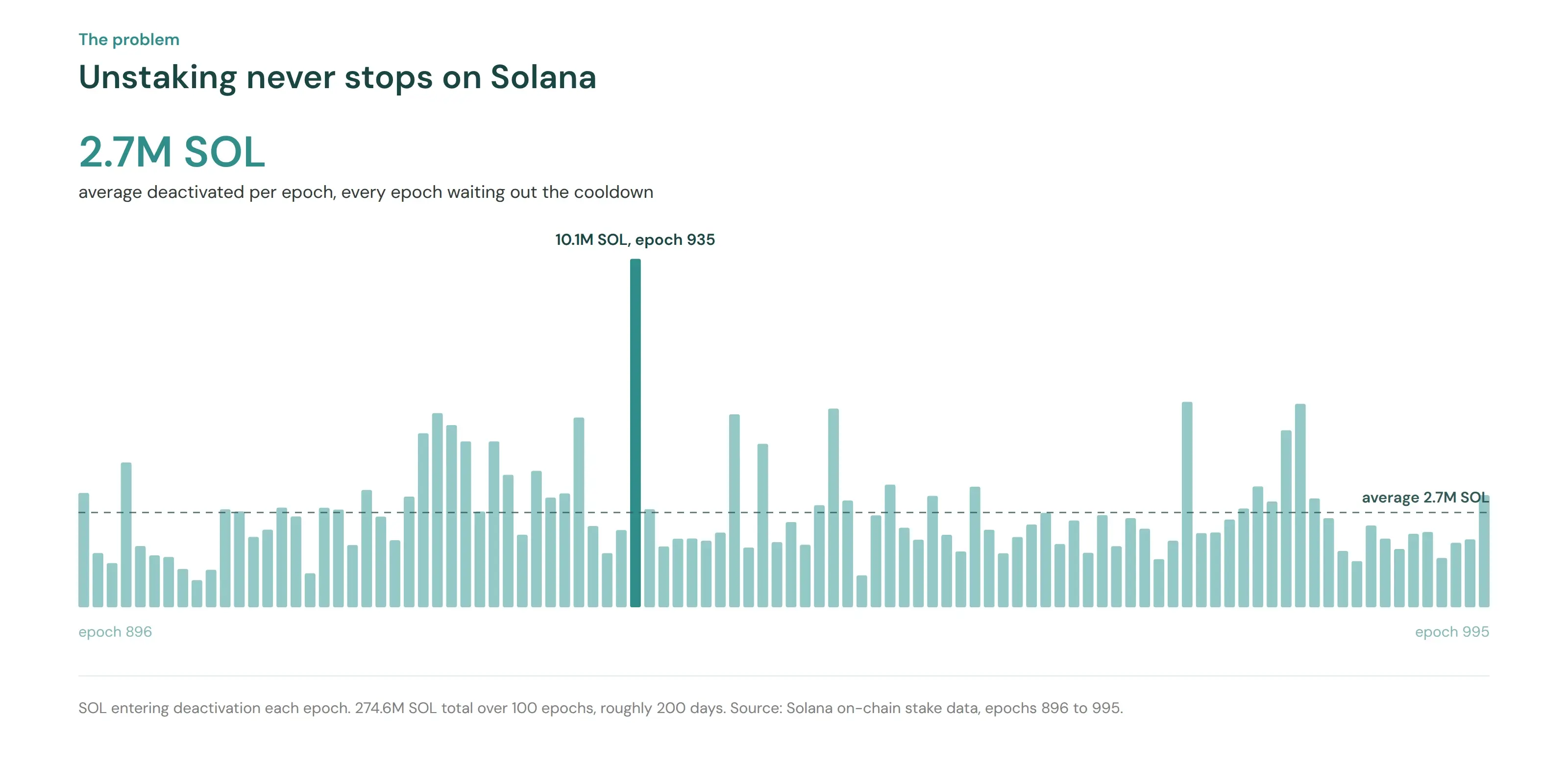
This is not a niche inconvenience. Over the last 100 epochs, 274 million SOL entered deactivation, an average of 2.7 million SOL every epoch. Each of those positions waited out the cooldown before the SOL could move. And the flow is spiky: single epochs have seen more than 10 million SOL deactivate at once, typically when the market moves and everyone wants liquidity at the same time.
If SOL moves sharply, an opportunity appears elsewhere, or a treasury needs to rebalance, a two-day wait is expensive. Capital sits idle. Trades get missed. Risk cannot be managed on the timeline the market demands. For a desk or a fund, an unpredictable exit window is an operational problem, not a minor inconvenience.
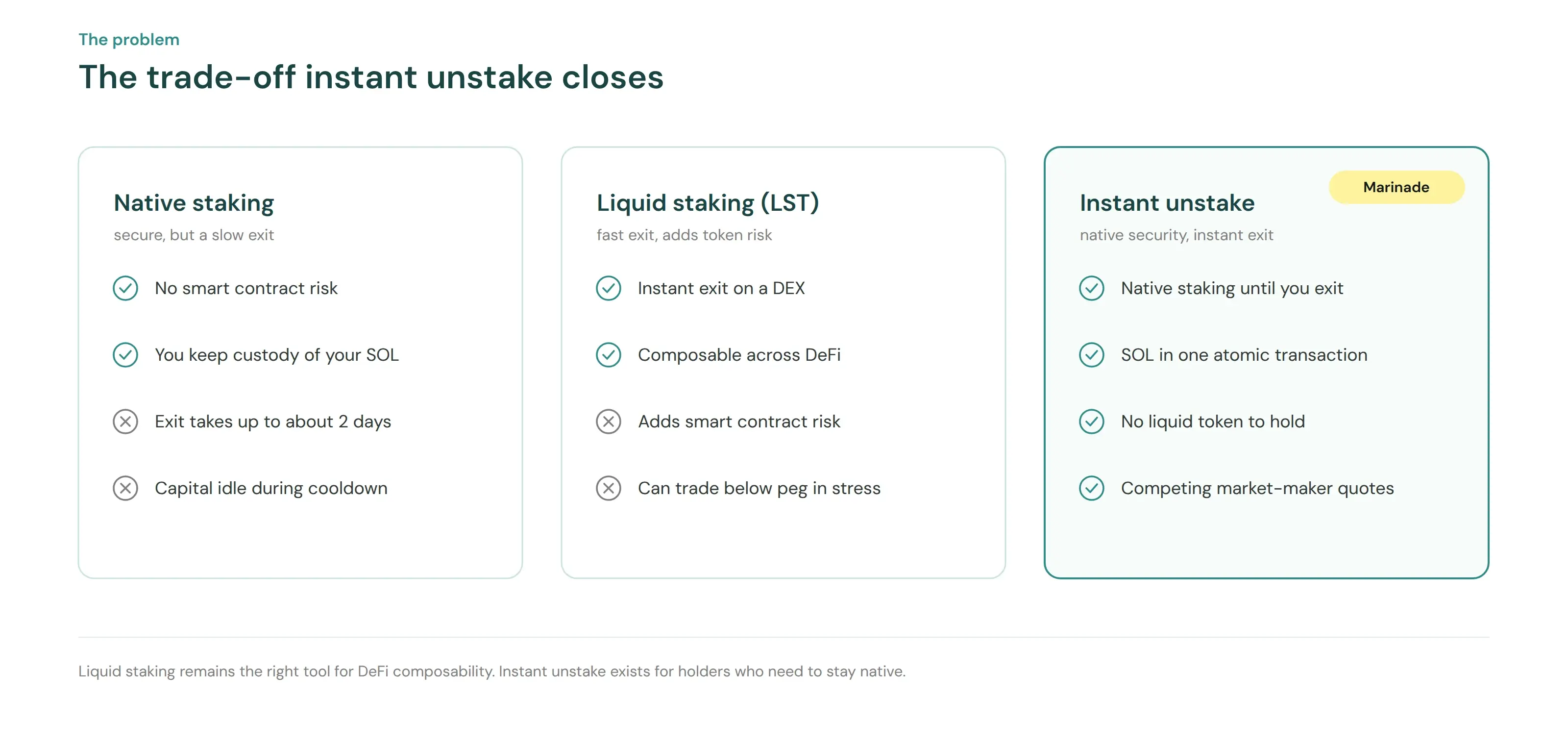
The standard workaround is a liquid staking token. You stake through a protocol, receive a token such as mSOL that represents your position, and sell that token on a decentralized exchange whenever you want out. Liquid staking is a strong product, and Marinade offers it. But for some holders it introduces trade-offs that native staking does not have.
- Smart contract risk. A liquid staking token lives inside a smart contract. That code is audited, but it is still an additional surface that native staking avoids.
- Depeg risk. A liquid staking token can trade below the value of the SOL it represents during stress. In December 2023, mSOL fell by as much as 18 percent in a single session after one wallet offloaded more than 5 million dollars of the token, dropping from around 77 dollars to below 67 before recovering above 77 within roughly an hour and a half. Anyone forced to exit in that window realizes the discount.
- Accounting and custody constraints. Many institutions cannot or will not hold a liquid staking token. It has a different custody, accounting, and tax profile than a native staked position, and some mandates simply do not permit it.
So there has been a gap. Native staking gives you custody and a clean risk profile but a slow exit. Liquid staking gives you a fast exit but adds token risk. Instant unstake closes that gap.
The solution: Marinade Instant Unstake
Marinade Instant Unstake, built in collaboration with Anza, lets you exit a native stake account immediately. You keep native staking right up to the exit. You do not wrap your position into a token. You do not wait for the epoch. You receive SOL in a single transaction.
It works for stake accounts delegated to any validator, not only stake delegated through Marinade. When you connect your wallet, Marinade detects your eligible native stake accounts on-chain, including positions that were never created through Marinade. You choose how much to unstake, review a quote, and confirm.
The mechanism behind that quote is what makes it work at size and safely.
How the RFQ market-maker system works
Instant Unstake uses a request-for-quote (RFQ) model. RFQ is a standard structure in traditional and crypto markets for trading in size. Instead of pushing your order into a public pool, you request a firm price, and professional liquidity providers compete to fill it.
Here is the flow for a native instant unstake:
- You start an unstake in the Marinade app and choose Instant.
- Marinade sends a request to a marketplace of KYC market makers.
- Those market makers return competing quotes to buy your stake account.
- Marinade shows you the best quote received, as an all-in number.
- You review the estimated SOL you will receive and approve the transaction in your wallet.
- The stake account transfers to the buyer and the buyer sends you SOL in the same transaction.
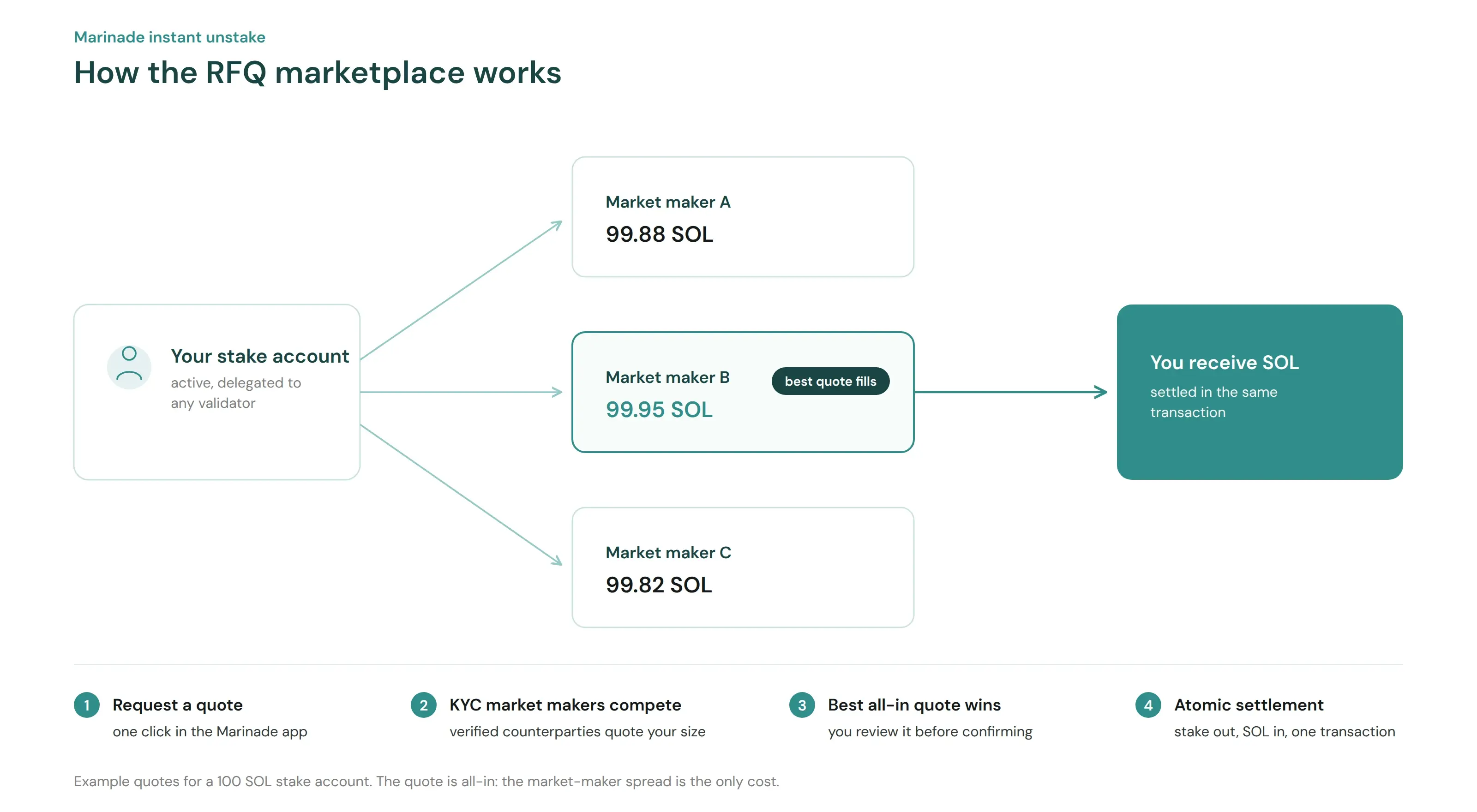
Because the market makers are known, verified counterparties rather than an open pool, the system can support larger, institutional-grade sizes and clean settlement. The market makers take on the cooldown wait themselves. They buy your active stake account and manage the deactivation on their own timeline. You get SOL now.
Why the quotes are competitive
Competition is the point of an RFQ. When several market makers quote the same request, the best price wins. That structure pushes pricing toward the tightest spread the market can offer for your size, rather than a single fixed rate.
Marinade also compares routes. For a native stake account, the request can be filled by a market maker taking the stake directly, or routed through Marinade's own stake pool liquidation path, whichever gives you more SOL. You always see the best quote before you commit, and if you do not like it, you can switch to delayed unstake and use the standard one-epoch flow instead. That fallback matters. You are never forced to accept a quote you do not like.
What atomic execution means for you
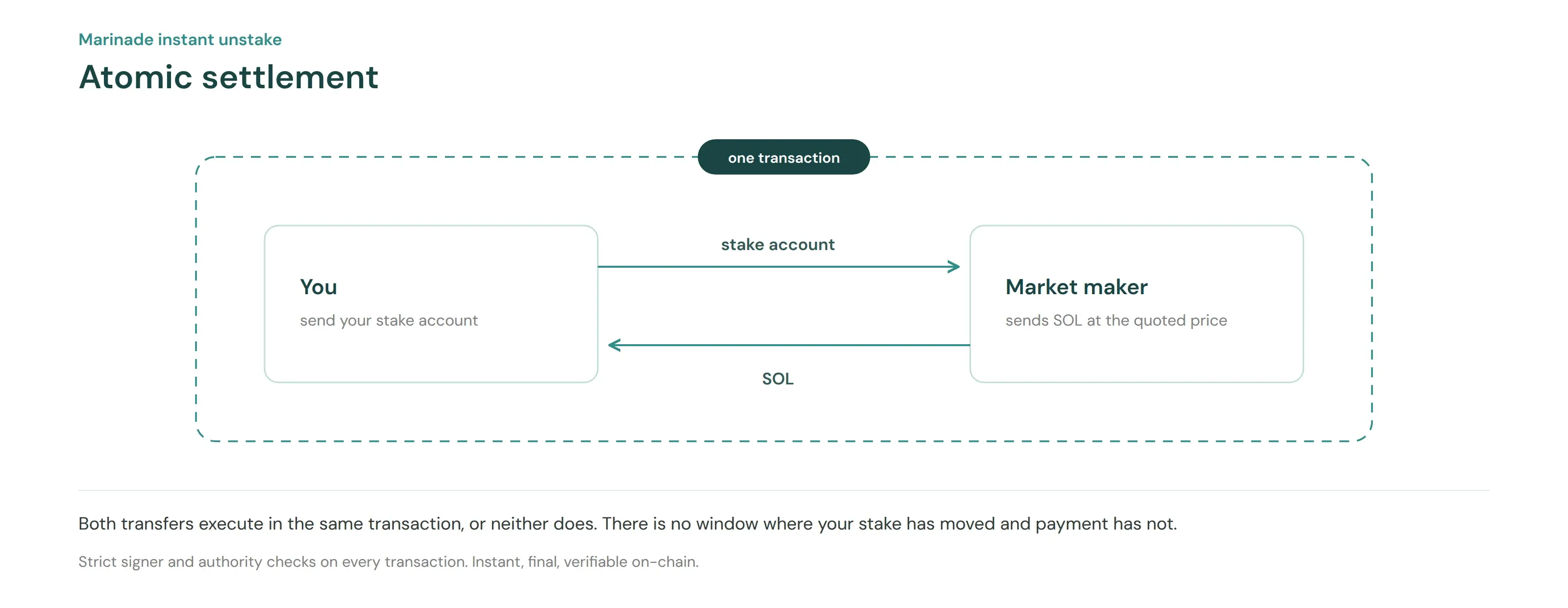
The settlement is atomic. Both sides of the trade execute in the same transaction, or neither does. Your stake account only transfers if the buyer's SOL transfers to you at the same moment.
This removes counterparty settlement risk. There is no window where you have handed over your stake and are waiting for payment. There are no partial fills on the atomic path. Every transaction includes strict signer and authority checks, so only authorized stake accounts can move. The result is instant, final, and verifiable on-chain.
Marinade has also described a limit-order path via an auction, where a stake account is escrowed into a program at a user-defined minimum price, supporting partial fills and cancelable orders. This is a planned enhancement rather than the current default, and details may change before it ships.
Fees and pricing
Marinade does not add a separate, itemized protocol fee on native instant unstake. The cost to you is the market-maker spread, and it is built into the quote you see. What you see is what you get.
Marinade's documentation describes that embedded cost as dynamic, typically between 3 and 20 basis points (0.03 to 0.20 percent), and states that the quote shown in the app reflects the full execution price, including any fee or spread. Pricing is set by an open market and depends on how market makers quote liquidity at that moment.
Compare that with the delayed native unstake path, which carries a flat Marinade unstake fee of 0.003 SOL, deducted from your wallet as a separate SOL deduction at the time of the transaction. (A 0.2 percent, or 20 basis point, fee introduced under MIP-18 applied from March to early July 2026 before being disabled.) The practical takeaway is simple. On instant unstake you pay a market-set spread inside the quote. On delayed unstake you pay a fixed protocol fee but wait an epoch.
Who Instant Unstake is for
- Native stakers who want the security of self-custodied staking without giving up a fast exit.
- Institutions, funds, and treasuries that need instant liquidity but cannot or will not hold a liquid staking token.
- Larger holders who need to move size and want competitive, all-in pricing rather than open-market slippage.
If you are moving institutional size, Marinade's team can help with onboarding and integration through the institutions page.
Instant unstake vs delayed unstake vs liquid staking
- Instant unstake. SOL now, in one transaction. Price is a competitive market-maker quote. Best when you need liquidity immediately and want to stay in native staking.
- Delayed unstake. SOL after one epoch, then you return to claim. A flat 0.003 SOL fee applies. Best when you can wait and want to avoid market pricing.
- Liquid staking with mSOL. Hold a token you can sell or use across DeFi at any time. Best when you want composability and are comfortable holding a liquid staking token.
Each has a place. Instant unstake exists so that choosing native staking no longer means accepting a slow exit.
How Instant Unstake fits Marinade's stack
Instant unstake is one part of a native staking product designed to remove the historic trade-offs of staking on Solana.
- Marinade Native routes your stake to high-performing validators through the stake auction marketplace while you keep custody.
- Protected Staking Rewards backs your yield with validator bonds, covering losses from downtime or commission changes.
- The Staking Rewards Report gives you an exportable summary for audits and tax.
- The Solana Staking Index gives you a neutral, protocol-neutral benchmark to judge whether your yield is competitive.
Together these mean you can stake natively, measure your performance against a public benchmark, protect your rewards, and still exit instantly when you choose.
FAQ
How long does it take to unstake SOL on Solana?
A standard native unstake takes up to about two days, or one full epoch. You deactivate the stake account, it cools down until the next epoch boundary, and then you withdraw. With Marinade Instant Unstake you receive SOL in a single transaction instead of waiting.
Why is there a cooldown period when unstaking Solana?
Solana processes stake changes only at epoch boundaries and limits how much stake can deactivate per epoch to no more than 25 percent of total active stake. This protects network stability. The cooldown is the result of that design, not a Marinade rule.
How much SOL gets unstaked on Solana?
Over a recent 100-epoch window, about 274 million SOL entered deactivation, an average of roughly 2.7 million SOL per epoch. Peak epochs have seen more than 10 million SOL deactivate at once. All of it waits out the cooldown before it can move.
Do I keep earning rewards while my stake is deactivating?
Yes. Deactivating stake keeps earning for the rest of the epoch in which you unstaked. Rewards auto-compound into the stake account, so you do not lose the current epoch's rewards by starting a deactivation.
Does Marinade Instant Unstake require a liquid staking token?
No. Instant unstake works directly on native stake accounts. You do not wrap your position into mSOL or any other token, so you avoid the smart contract and depeg risk that comes with holding a liquid staking token.
Can I instantly unstake a stake account that was not created through Marinade?
Yes. Marinade detects eligible native stake accounts in your wallet across any validator, including ones you delegated elsewhere, and can process multiple stake accounts in a single transaction.
Is Instant Unstake safe?
The trade settles atomically. Your stake account transfers only if the buyer's SOL transfers to you in the same transaction, so there is no settlement counterparty risk. Every transaction includes strict signer and authority checks. Your SOL stays in native staking until the moment you exit.
What does Instant Unstake cost?
There is no separate protocol fee on native instant unstake. The cost is a market-maker spread built into the quote you review before confirming, which Marinade's documentation describes as typically 3 to 20 basis points depending on market conditions. If you prefer to avoid market pricing, the delayed unstake path charges a flat 0.003 SOL fee and returns your SOL after one epoch.
What if I do not like the quote?
You can decline it and switch to delayed unstake, which follows Solana's standard one-epoch flow. You are never forced to accept an instant quote.